About the project

A long-term African–European partnership on climate risk and resilience

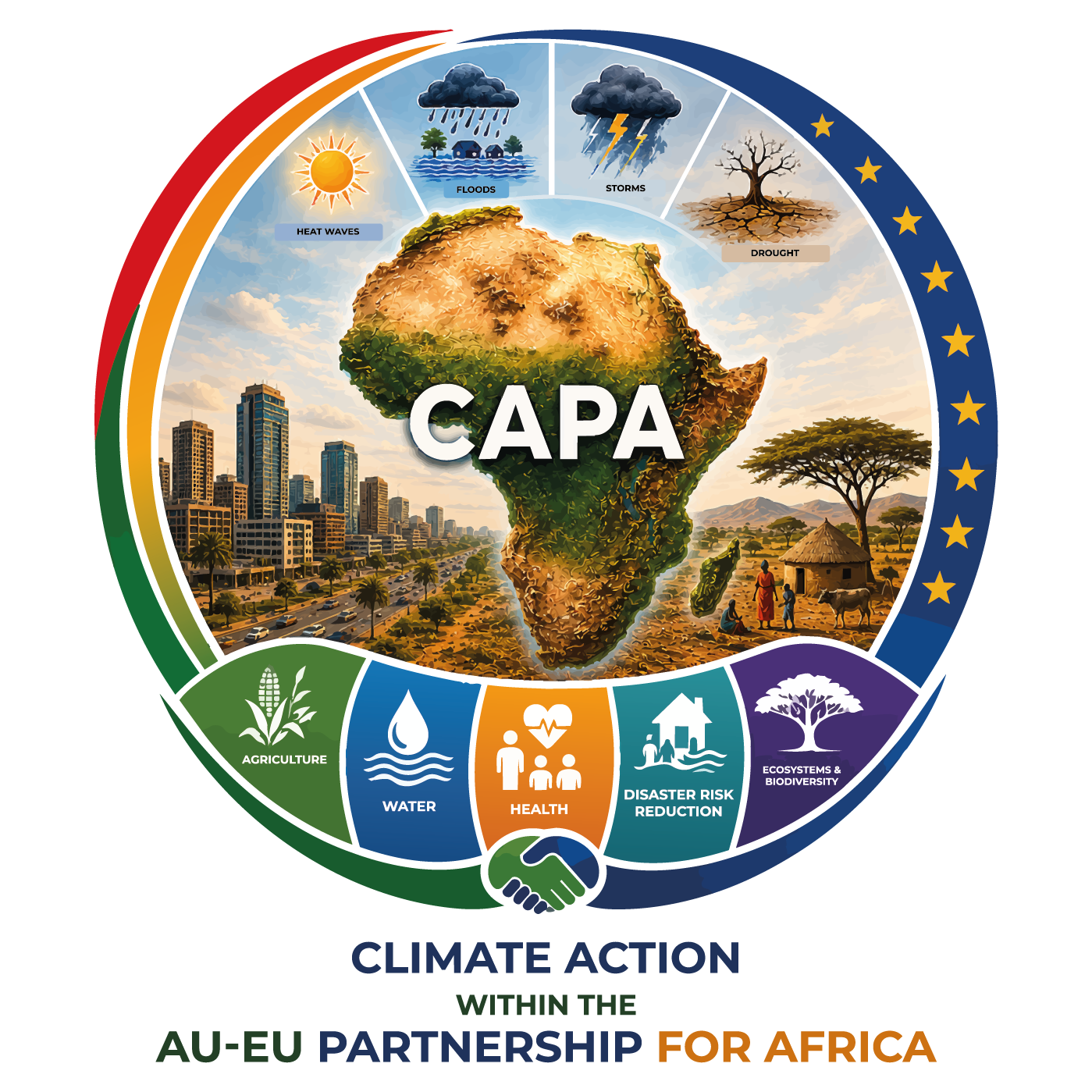
CAPA illustration: climate hazards and sectors around the African continent

Addressing these risks and adaptation requires more than fragmented data and behaviours: it demands coordinated action, inclusive knowledge, and durable partnerships between countries, regions and continents.

Despite Africa contributing weakly to global greenhouse gas emissions, the continent bears a disproportionate brunt of climate impacts on vulnerable urban and rural communities from various hazards (heat waves, droughts, floods, cyclones,dust storms…), exacerbating hunger, insecurity and displacement.

CAPA (Climate Action within the AU-EU Partnership for Africa) is a transdisciplinary consortium bringing together African and European scientists, policymakers, funders, service providers, and communities to strengthen disaster risk reduction and climate resilience across the five African regions. The project addresses cascading impacts that cross sectors, such as the security of people, goods and property, water resources, food, energy and health.

Based on extensive mapping, CAPA will develop a joint roadmap 2028–2034 with implementation priorities on research, innovation and capacity, will organise regional and pan-African forums for cross-view, and will implement demonstrators for e-learning and education. It integrates both scientific expertise and local knowledge to develop climate services that are relevant, accessible, and actionable for local/regional communities and sectors.

CAPA gathers 14 African and 9 European institutions across 17 countries, with five African universities representing all five African regions. Together, they will co-design a continental roadmap, develop regional action plans, and build long-term institutional capacity.

Towards a Long-term European-African Partnership on Climate Risk Reduction and Resilience (LEAP-Clim) of the CCSE Climate Pillar, CAPA project (2026–2029) is its second component to forge the joint roadmap 2028-2034, after a first multilateral demonstrator in West Africa (CS4RRA 2023–29). It will be complemented by research projects under selection in 2026 and by a Co-fund project in 2027.

Overall CAPA will contribute to the African Union’s Agenda 2063, the 6 STI Areas of Interventions in the Environment Sector of STISA 2034, and the European Union Framework Programme on Research and Innovation for 2028–2034.

Aligning existing climate initiatives and fostering coordinated investment between African and European countries, CAPA will strengthen African climate science and services to reduce vulnerability of communities within their regional specificities. It operates under Open Science and FAIR principles, ensuring that data, methods, and results remain findable, accessible, interoperable, reusable and African-owned.
Structure

Seven work packages

Each work package is led by one consortium partner and interconnected with the others.
01
Led by
IRD

Coordination and management

The coordination and management work package (WP1) aims at ensuring an overall and efficient execution of the project (7 WPs), by maximising reciprocal collaboration, services and impacts for climate risk reduction and resilience within African regions. Activities include: scope definition and planning at project and WP level; management and coordination of work across WPs, regular communication with the Consortium and the EC; quality assurance, risk analysis and adaptive measures, approval of deliverables and reports, data management and FAIR principles, intellectual property, gender/ethical issues and conflict resolution.

Aerial view of cultivated plots and tracks laid out around a settlement
02
Led by
AfRC

Joint roadmap and implementation strategy

This WP will develop a trust-building approach, rooted in African regions, between the different stakeholders to strengthen the EU-AU cooperation on climate change research and actions, with a focus on climate risk reduction and resilience building in synergy with adaptation and mitigation measures. To tackle such a broad and complex challenge, a networking approach will be deployed to foster collaboration between research centres, specialised agencies, universities, funders and national authorities for disaster risk management and adaptation plan. In particular, this WP will closely cooperate and align with the CCSE roadmap and its associated expert group, as well as with the Energy pillar of the CCSE (i.e. CSA LEAP Energy Plus).

A large crowd gathered for an open-air meeting in a rural village
03
Led by
NRF

Funding priorities and engagement

This WP will develop funding concepts and mobilise commitments from national funding bodies, philanthropies, etc., necessary to implement joint AU-EU collaborative activities, including a potential Horizon Europe 2027 Co-fund action spanning 2028-2033, to implement climate change research, with a focus on climate risk reduction and resilience, building in synergy with adaptation and mitigation measures as an outcome of mainly WP2, 4, 5 & 6. The goal of this work package is to form a group of funding agencies that agree on a joint concept for a future Co-fund and on ways of implementing the latter. After completion of this work package, we will have developed a concept for a future Co-fund and have established a platform of funding agencies and philanthropies willing to engage in this joint funding initiative.

Women trading at an open-air market
04
Led by
NORCE

Climate services-related knowledge in Africa

This WP will synthesise and consolidate existing scientific knowledge related to climate services in Africa, ranging from hazard forecasts and scenarios to vulnerability assessments, focusing on key initiatives, programmes and projects at continental and regional levels. It will promote strategic coordination and shared learning across AU–EU initiatives by synthesising knowledge, enhancing accessibility, and informing future collaborations. WP4 will serve as the knowledge synthesis component of the project Community Hub. Building on the legacy of past and existing projects and initiatives across Africa, WP4 will map relevant projects and initiatives, identifying and curating key outputs, and facilitating and sharing knowledge and learning within and outside the project. This will be achieved through three complementary tasks.

Weather radar domes on their towers against cloud
05
Led by
ACMAD

Operational services for resilience solutions

This WP focuses on service dissemination, co-production, integration with national and regional infrastructures and knowledge/governance systems, as well as assessments of the impacts of climate services. From mapping the existing climate services being deployed across the African continent, the task will assess, through case studies, the impactful regional and community-based services for effective resilient practices and solutions across Africa. Then recommendations for the Joint Roadmap and Implementation Strategy (WP2) will be made by identification of gaps and by integration of mapped products to improve services and practices for climate-resilient development of multisectoral communities. This WP will synthesise information to assess and provide guidelines for operational services for improved resilience practices and solutions, based on climate services being provided by WMO’s NMHSs and regional climate centres, such as ACMAD for whole Africa, ICPAC for Eastern Africa, WASCAL for Western Africa and DGM as coordinator of the Regional Climate Centre Network for Northern Africa (Morocco, Algeria, Tunisia, Libya, Egypt). DGM will be a subcontractor of WMO. LGI will lead the effort to map private-sector providers. At the same time, AfRC, PAFO and JOKA will bring needs and feedback from sectors covering civil security, finance, social protection, planning, agriculture and media.

An automatic weather station on an exposed hilltop
06
Led by
RU-FEAH

Training for Capacity Development

This WP will design and deliver training and capacities for AU climate science, policy and actions within specific sectors and regions, including citizen science and indigenous knowledge. The task in year 1 will develop, with all WP6 partners, a joint strategy that includes mapping, guidelines and training curriculum. In year 2 and 3, such strategy will implement “train-the-trainers” demonstrators targeting Early Warning Systems educational systems with Transdisciplinary Schools and continuing education with Professional Development Labs. Guidelines and learned lessons from tasks will be shared on an e-learning platform (with WP7) following an adaptive approach. This WP6 is closely interconnected with WP2 (engaging African researchers and practitioners, regional forums), WP5 (climate services co-production), WP4 (climate service knowledge), WP7 (communication and dissemination) and will build the training component of the CAPA Community Hub.

A teacher working through a lesson at the board with a class
07
Led by
LGI

Communication and dissemination

This task will develop a communication strategy and outreach strategies and will support other WPs’ stakeholder engagement strategy, uptake by policy makers, private sector and community actors, and use FAIR principles for data management. It will build tools and use CAPA media, such as the website and a Community Hub platform to share and disseminate data and information, either for internal or external purposes. To insure a large visibility and accessibility to the African audience, the pan-African Open Access portal AfricArXiv will be used.

A seated group listening at a village meeting

Cookie settings

We use cookies only where they are needed: to remember the choice you make here, to measure how the site is used, and to load videos and maps hosted by others. Nothing is set until you have decided. Read our privacy policy.

Choose what the site may set. Your choice is kept for six months and can be changed at any time from the bottom of any page.

Required for the site to work. Today this is the single cookie that remembers the choice you make in this panel. It cannot be turned off.

Anonymous statistics on the pages visited, so we know which parts of the site are useful. No advertising, and nothing shared with third parties.

Videos and maps embedded in our pages. Their providers set their own cookies the moment the content loads, which is why it stays blocked until you accept.